You served your country. Now you want to use your benefits and get a degree in Ohio. But most states force you to sit through a 12-month residency waiting period before you qualify for in-state tuition — paying tens of thousands extra while you wait. Ohio eliminated that barrier. The Ohio GI Promise gives every qualifying veteran immediate in-state tuition at every public college and university in the state, from day one.
That single policy can save you more than $23,000 per year at a school like Ohio State. And it stacks directly with your federal GI Bill benefits. Here’s exactly how the program works, who qualifies, and how to lock it in before your first semester.
What the Ohio GI Promise Gets You
The Ohio GI Promise is straightforward: if you’re an eligible veteran domiciled in Ohio, you pay in-state tuition rates at every public college and university in the state. No waiting period. No 12-month residency clock. You’re treated as an Ohio resident for tuition purposes starting with your first enrolled term.
This applies to all 14 public four-year universities, all 23 community colleges, and every regional campus in the Ohio public higher education system. Whether you’re enrolling at Ohio State, the University of Cincinnati, Kent State, or Cuyahoga Community College — you get the in-state rate immediately.
The Dollar Difference
Let’s put real numbers on this. At The Ohio State University, out-of-state tuition runs approximately $35,000 per year. In-state tuition is approximately $12,000 per year. That’s a $23,000 annual difference. Over a four-year bachelor’s degree, you’re looking at $92,000 in savings just from getting the correct tuition classification from the start.
Similar gaps exist at every major Ohio public university. At the University of Cincinnati, you’d save roughly $15,000 per year. At Miami University, about $22,000. The GI Promise eliminates these premiums entirely.
How It Stacks With Your Federal GI Bill
The Post-9/11 GI Bill (Chapter 33) pays tuition and fees up to the in-state maximum at public institutions. The GI Promise ensures you actually receive that in-state rate. Without it, you could arrive in Ohio, enroll at a public university, and get charged out-of-state tuition — with the GI Bill only covering the in-state portion. You’d pay the difference out of pocket. The GI Promise closes that gap.
With both programs working together, the GI Bill covers your in-state tuition and fees, plus you receive the Monthly Housing Allowance (BAH at the E-5 with dependents rate) and $1,000 per year for books and supplies. The GI Promise doesn’t replace your GI Bill — it ensures the tuition rate your GI Bill pays is the lowest available.
Eligibility Requirements
To qualify for the Ohio GI Promise, you must meet three requirements:
- Service: At least one year of active duty military service.
- Discharge: Honorably discharged or medically separated from military service.
- Domicile: Domiciled in Ohio as of the first day of the term you’re enrolling in.
“Domiciled” means Ohio is your permanent home — you live here with the intent to stay. This is different from the standard residency requirement that counts calendar days. You can establish domicile by moving to Ohio, getting a lease or buying a home, obtaining an Ohio driver’s license, and registering to vote. The key is demonstrating intent to make Ohio your home, not proving you’ve lived here for a specific length of time.
Ohio National Guard Scholarship Program
If you’re currently serving in the Ohio National Guard — or considering joining — there’s another major tuition benefit that layers on top of the GI Promise.
The Ohio National Guard Scholarship Program (ONGSP) covers 100% of tuition at Ohio’s public colleges and universities. At private institutions, it covers the equivalent of the average tuition amount charged at Ohio’s public universities. That’s a significant benefit even at private schools.
Service Requirements
You must be an active drilling member of the Ohio Army or Air National Guard, maintaining satisfactory participation — drills, annual training, good standing. The scholarship covers undergraduate and graduate programs (priority to undergrads when funding is limited) and renews each semester as long as you stay active and maintain academic progress.
Stacking Guard Benefits With Federal Benefits
If you’re a Guard member with Post-9/11 GI Bill eligibility from a prior active duty period, you can use the ONGSP for tuition while preserving GI Bill months — or use the GI Bill’s housing allowance while the ONGSP handles tuition. Talk with your school’s veterans certifying official about the best order to apply benefits for your situation.
Stack all three: the GI Promise ensures the in-state rate, the ONGSP covers that tuition, and the GI Bill provides the housing allowance and book stipend. Used strategically, these programs together make your education functionally free.
Additional Ohio Benefits for Military Families
Ohio also extends education benefits to military families. The Ohio War Orphans Scholarship provides tuition assistance for children of deceased or severely disabled veterans, available to eligible dependents under age 25. Spouses of Ohio residents killed in a combat zone after May 7, 1975, qualify for free tuition at Ohio public institutions for up to four years. These programs exist alongside the GI Promise and Guard scholarship, covering gaps that federal survivor benefits might not fully address.
How to Apply for Ohio GI Promise
The application process is simpler than most veterans expect. There’s no separate state agency to deal with and no lengthy approval timeline. You handle everything through your school’s enrollment or financial services office.
Step 1 — Gather Your Documents
You need two things:
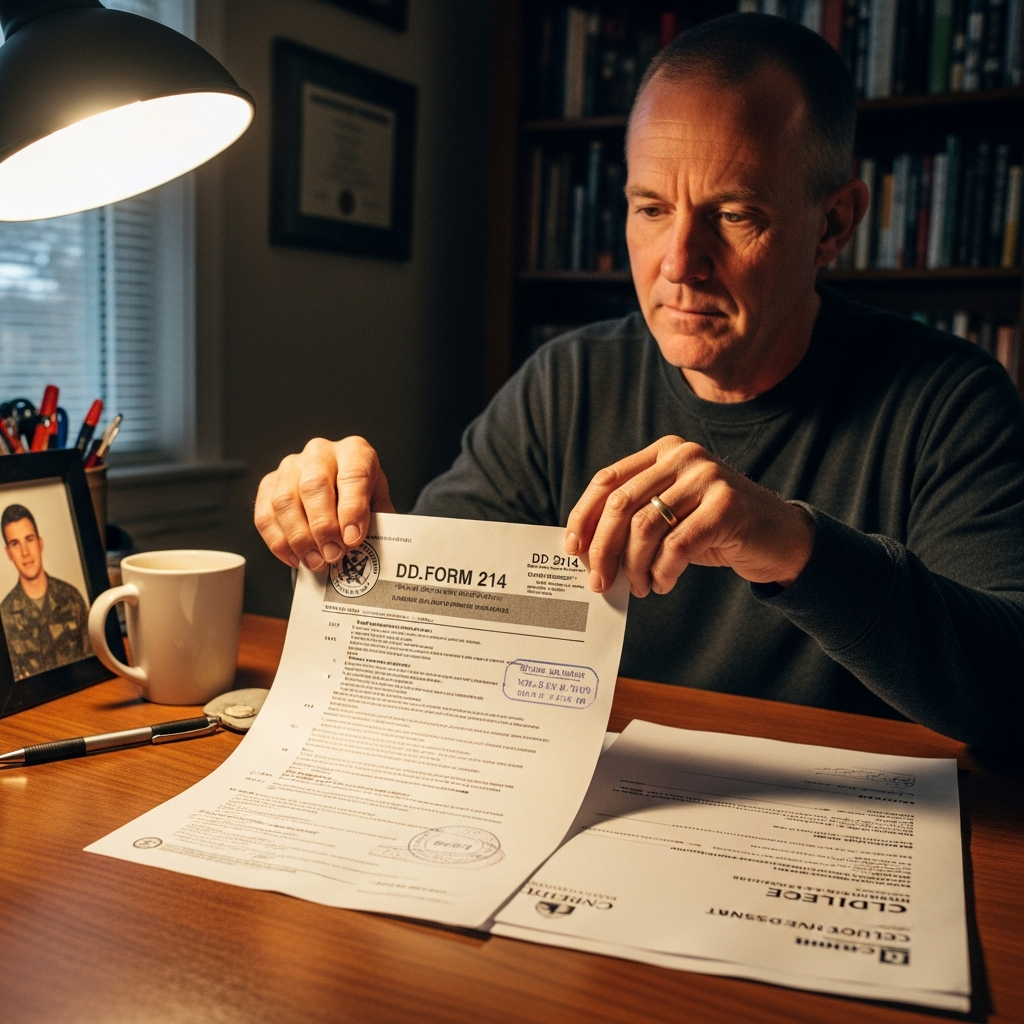
- DD-214, Member Copy 4: This is the “long form” copy that shows your character of service. Member Copy 1 (the short form) won’t work — it doesn’t include the discharge characterization schools need to verify your eligibility. If you’ve lost your DD-214, request a replacement through the National Personnel Records Center (NPRC) at archives.gov/veterans. Allow 6-8 weeks for processing, so don’t wait until the last minute.
- Ohio Residency Proof: Acceptable documents include a signed lease agreement, mortgage statement, Ohio driver’s license, Ohio vehicle registration, or a sworn affidavit of Ohio domicile. Your school may have a specific residency affidavit form — ask the registrar’s office.
Step 2 — Contact Your School’s Veterans Office
Before you submit anything, call or visit the veterans services office (sometimes called military services or enrollment services) at the school where you plan to enroll. Ask specifically about their GI Promise application process. Some schools have a dedicated form. Others handle it through the general residency reclassification process. Knowing the exact procedure at your school prevents wasted time and missed deadlines.
Step 3 — Submit Your Application Early
Submit your DD-214 and residency documentation to the enrollment or financial services office at least 7 days before your term starts. This is the minimum — submitting 30 days early is better. Processing times vary by school, and you do not want to see an out-of-state tuition bill on your student account because paperwork was still in queue when the semester began.
If your tuition classification isn’t updated before the payment deadline, contact the veterans office immediately. Most schools will place a hold on your account while the GI Promise application is processed, preventing late fees or enrollment cancellation.
Step 4 — Verify Your Tuition Classification
After submitting your documents, log into your student account and confirm that your tuition has been reclassified to the in-state rate. Don’t assume it happened — verify it. If you still see out-of-state charges, follow up with enrollment services immediately. Mistakes happen, and catching them early is far easier than requesting a retroactive refund weeks into the semester.
Need Help? Call the Ohio Veterans Hotline
If you hit any roadblocks — missing documents, confusing school procedures, eligibility questions — call the Ohio Department of Higher Education veterans line at 1-877-VETS-OH-1 (1-877-838-7641). They can walk you through the process and intervene with schools if needed. Ohio also has 88 County Veterans Service Offices across the state that provide free, in-person assistance with benefits applications and document gathering.
Best Ohio Schools for Veterans Using GI Promise
Not all schools serve veterans equally. When choosing where to enroll, look beyond tuition rates. Consider veteran enrollment numbers, dedicated support services, campus BAH rates, and transfer pathways if you’re starting at a community college.
Top Ohio Schools by Veteran Enrollment and Support
These Ohio public institutions consistently rank among the best for veteran students based on enrollment numbers, dedicated veteran services, and program outcomes:
- The Ohio State University (Columbus) — One of the largest veteran populations in the Big Ten. Dedicated Veterans and Military Families office, priority registration, and veteran-specific academic advising.
- University of Cincinnati — Strong veteran support through their Veterans Programs and Services office. Multiple campuses offer flexibility for working veterans.
- Kent State University — Operates a dedicated Veterans Resource Center and has been recognized as a Military Friendly school consistently.
- Wright State University (Dayton) — Located near Wright-Patterson Air Force Base. Heavy veteran and military enrollment. Veteran and Military Center on campus.
- Ohio University (Athens) — Veteran-specific orientation programs and a Military and Veterans Services office that handles benefits certification and peer mentoring.
- University of Akron — Dedicated Military Services Center with veteran-specific tutoring and career services.
- Cleveland State University — Viking Veterans services office and strong connections to Cleveland VA Medical Center for health-related programs.
- Cuyahoga Community College (Cleveland area) — Largest community college in Ohio. Veteran enrollment consistently high. Excellent transfer agreements with four-year schools.
- Columbus State Community College — Strong veteran support services and guaranteed transfer pathways to Ohio State for qualifying students.
- Sinclair Community College (Dayton) — Significant veteran population due to Wright-Patterson proximity. Veterans Services office handles GI Bill certification and GI Promise documentation.
BAH Rates Matter — Choose Your Campus Wisely
If you’re using the Post-9/11 GI Bill, your Monthly Housing Allowance is based on the zip code of your campus, not where you live. This means campus location directly affects your monthly income. Major metro campuses in Columbus, Cincinnati, and Cleveland typically offer higher BAH rates than rural campus locations. The difference can be $300-500 per month — real money over a four-year degree.
Check the current BAH rates for any campus you’re considering at the VA’s GI Bill Comparison Tool. A school with slightly higher tuition but a significantly higher BAH rate might put more money in your pocket overall, especially when the GI Promise and GI Bill cover tuition completely.
The Community College to Four-Year Transfer Pathway
Starting at an Ohio community college and transferring to a four-year university is one of the smartest moves a veteran can make — and the GI Promise covers both legs of that journey.
Ohio’s Transfer Assurance Guides (TAGs) and the Transfer Module guarantee that courses completed at one Ohio public institution transfer to another. If you earn an associate degree at a community college, many four-year schools guarantee junior standing upon transfer. Columbus State to Ohio State is a well-worn path. Cuyahoga Community College to Cleveland State is another. Sinclair to Wright State works seamlessly for Dayton-area veterans.
Why start at a community college? The GI Promise ensures you pay in-state tuition at both institutions. Your GI Bill months are preserved because community college tuition is lower, meaning the GI Bill covers it easily with months to spare for the four-year school. Class sizes are smaller, advising is more accessible, and the academic on-ramp is smoother after years away from a classroom.
Complete your general education requirements at a community college, transfer with an associate degree, and use your remaining GI Bill months to finish a bachelor’s degree. This two-step approach stretches your benefits further and increases your chances of graduating — which is the entire point.
Your Next Step
Pick your school. Call their veterans office. Ask specifically about the GI Promise application and what documents they need from you. Have your DD-214 Member Copy 4 and residency proof ready to submit at least 7 days before the term starts — earlier is better. If you need help navigating the process, call 1-877-VETS-OH-1 or visit your nearest County Veterans Service Office. Ohio built this program to get veterans into classrooms faster. Use it.