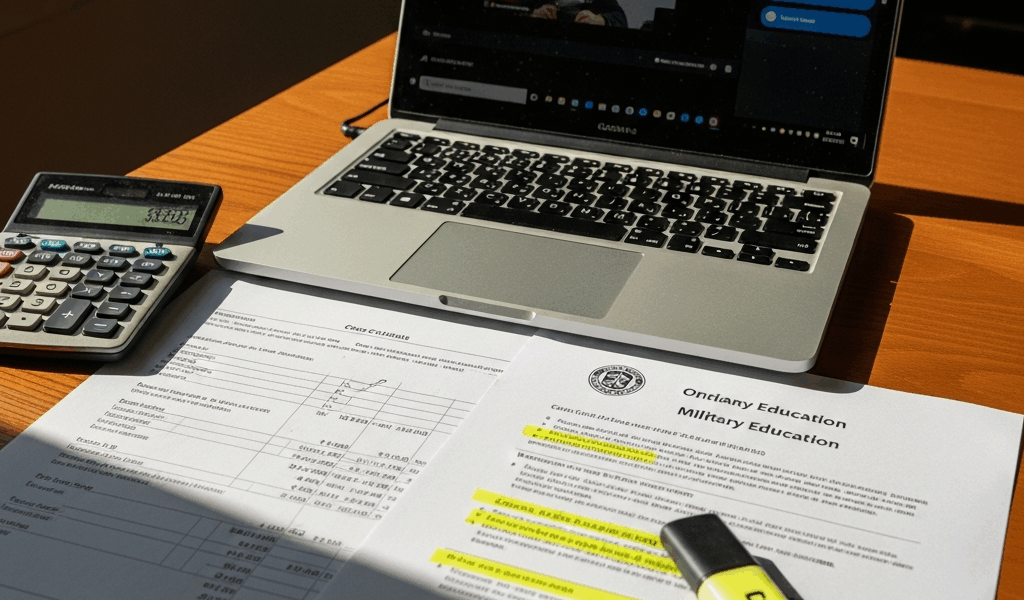
Why Your Housing Allowance Might Be Half What You Expected
GI Bill housing allowance has gotten complicated with all the conflicting information flying around — and most veterans don’t figure out what went wrong until they’re already short on rent money.
You checked the VA payment portal this morning and your jaw dropped. The recruiter’s office said $2,100 a month. You’re staring at a deposit for $1,050. So what happened?
You enrolled exclusively online. That’s it. The Department of Veterans Affairs pays exactly 50 percent of the Monthly Housing Allowance rate when every single class is remote. Not a glitch. Not a processing error. That’s the actual policy, buried somewhere on page three of materials nobody reads out loud.
Most veterans hit that deposit and immediately assume the VA miscalculated. School advisors gloss over it during orientation — if they mention it at all. Then you’re sitting in your apartment Googling whether you can dispute a VA payment while your landlord waits on a check.
You didn’t misunderstand anything fundamental. The half-rate rule is real, and for a full-time online student it quietly erases somewhere between $12,000 and $18,000 in annual housing support. But here’s the part worth knowing: there’s a loophole. One in-person class per term changes your entire payment calculation. Today, I’ll share exactly how that works — and what to do if the damage is already done.
How the GI Bill Calculates Housing Allowance
But what is the Monthly Housing Allowance, really? In essence, it’s a location-based rate the VA assigns to your school’s main campus ZIP code. But it’s much more than that — because that single ZIP code determines thousands of dollars in annual income depending on where you study.
San Diego’s 92101 ZIP pulls something around $2,800 a month right now. Rural Montana might land at $800. Same benefit, wildly different outcome based entirely on geography.
Full-time, in-person students at that campus get the full MHA rate. Full-time online-only students get half. Period.
Here’s the math with clean numbers. School MHA is $2,000 per month. On-campus, full-time: you receive $2,000. Online-only, full-time: you receive $1,000. That’s a $12,000 annual gap between you and the student doing the same Zoom lecture — except they physically walked into a building once this semester.
It compounds. Half-time enrollment — say, 6 credit hours instead of 12 — cuts the rate in half again. A half-time online student at that same school walks away with $500 a month. The numbers spiral fast in the wrong direction.
One thing the VA does not care about: whether your online class is a live 8 a.m. synchronous lecture or a self-paced module you finish at midnight on a Sunday. Doesn’t matter. Enrollment method is the only variable that triggers the half-rate calculation. Content, format, effort — irrelevant.
The Hybrid Enrollment Loophole Most Veterans Miss
Here’s where strategy actually changes the game.
The half-rate penalty only applies when every single class is online. Add one in-person course — even one credit hour — and you’re reclassified as a hybrid student. That single reclassification restores the full campus MHA rate.
I’m apparently someone who had to complain to four separate VA representatives before getting a straight answer, and the fourth one finally knew the actual policy. Don’t make my mistake. Get this answered before you enroll, not after three confusing phone calls.
Back to the numbers: full MHA at your campus is $2,000. You take one 3-credit in-person seminar per semester alongside nine online credits. Your monthly rate jumps from $1,000 back to $2,000. That’s $12,000 a year recovered by attending one class in a physical room.
Some schools make hybrid scheduling easy. Others make it a bureaucratic obstacle course. A few — certain for-profit online programs, specifically — don’t offer in-person options at all. If that’s your school, you’re locked into the half-rate and the loophole doesn’t apply.
Worth noting: this only works for Post-9/11 GI Bill users. Chapter 30 (Montgomery GI Bill) and Chapter 35 (Dependents Education Assistance) run different calculations entirely. No hybrid loophole, but also no half-rate penalty the same way. Different rules, different math — confirm which chapter you’re using before building any kind of enrollment strategy around this.
Enrollment Certification and Timing Mistakes That Delay Payment
Even veterans who understand the half-rate rule perfectly still get shorted — because the school side of this process fails constantly.
Your school’s Certifying Official submits your enrollment details to the VA. Late submission means late payment. Incomplete submission means the VA either processes bad data or holds the payment entirely while they wait for clarification. You won’t necessarily know any of this is happening.
I once had a payment delayed six full weeks because my school’s Certifying Official forgot to note an active-duty period during my enrollment. The VA couldn’t move forward without that detail. Nobody called me. Nobody flagged it. I found out by dialing the Education Call Center at 1-888-442-4551 and asking directly why nothing had hit my account.
Common delays and errors:
- School submits certification 10+ days after the semester starts instead of before it
- Certifying Official marks you half-time when you’re actually full-time, or vice versa
- You drop a class mid-semester and the school forgets to update the VA immediately
- School certifies you as online-only even though you registered for one in-person course
- Enrollment changes across semester breaks never get communicated at all
If your payment changes unexpectedly mid-term, go straight to your school’s Certifying Official and ask what they actually reported. Don’t assume the VA received accurate information. Many schools batch-submit certifications once a month — not in real time.
If the VA overpaid you because of someone else’s error — school or VA, doesn’t matter — you can request a debt waiver. They don’t grant them automatically, but if the overpayment traces back to their mistake rather than yours, the waiver process exists for exactly that situation.
How to Check Your Rate and Fix a Wrong Payment
Probably should have opened with this section, honestly. But here’s the process.
Pull up the VA GI Bill Comparison Tool at benefits.va.gov/gibill. Search your school by name. The tool displays the MHA rate for the main campus location. Compare that number to your actual monthly deposit. Getting half that amount with an all-online schedule? That’s your answer right there.
If the math still doesn’t line up, call the VA Education Call Center at 1-888-442-4551. Have your claim number ready before you dial. Ask them two specific questions: what enrollment status do they have on file — online-only or hybrid — and what MHA rate is being applied to your calculation. Those two answers will tell you whether the school reported incorrectly or whether the VA is running the wrong number on their end.
Overpayments become debts. The VA will come back for that money. If the error wasn’t yours, request a waiver using VA Form 20-7131. Yes, that form has a genuinely absurd official name — Claim for Family Dental Care. Use it anyway. It’s the correct form for debt waiver requests regardless of what the title says.
That said, the real fix is catching this before enrollment. Call your school and ask whether you can register for even one in-person class per semester. If the answer is yes, do it. The extra housing allowance will cover the commute costs and then leave money on the table — which is a better problem to have than the one you started with.