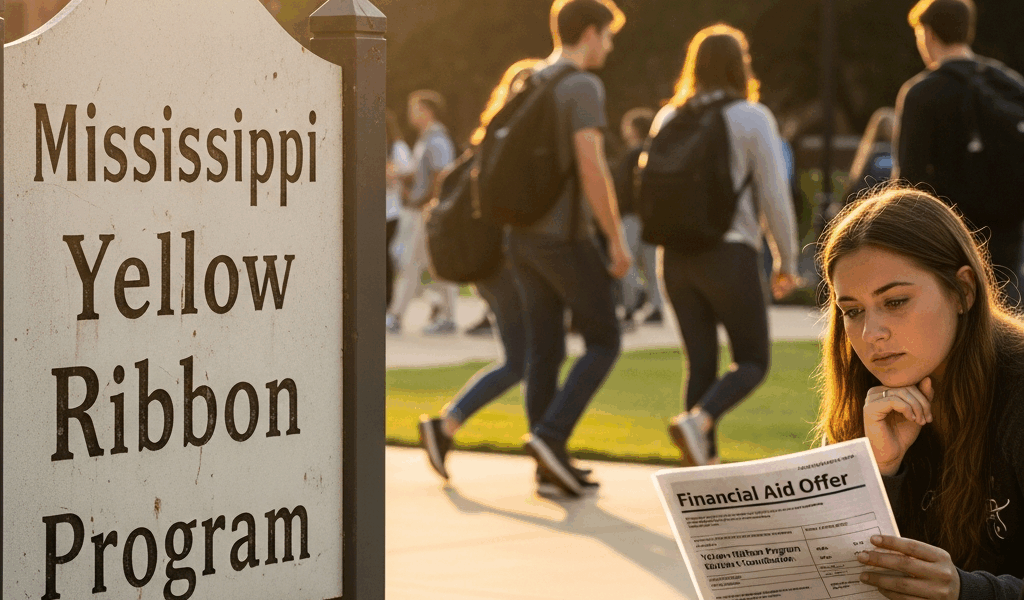
What Is the Yellow Ribbon Program?
The Mississippi Yellow Ribbon Program has gotten complicated with all the conflicting information flying around — and honestly, the VA’s own website doesn’t help. I spent about three hours clicking through benefits.va.gov one Tuesday afternoon, coffee going cold on my desk, before the actual mechanics finally clicked. Here’s what the formula looks like when you strip away the bureaucratic language and just write it out plain.
But what is the Yellow Ribbon Program? In essence, it’s a provision inside the Post-9/11 GI Bill (Chapter 33) designed to close the gap at schools where tuition runs higher than what the GI Bill’s in-state public rate covers. But it’s much more than that — it’s the difference between a veteran writing a $10,000 personal check every semester and writing none at all. Without Yellow Ribbon, a vet attending a private Mississippi university charging $38,000 in annual tuition eats that difference out of pocket. With it — at the right school, in the right year — that gap disappears entirely.
Here’s how the funding formula actually works:
- The VA pays tuition up to the in-state public school cap for the state where the school is located.
- The participating school voluntarily contributes up to 50% of the remaining tuition balance — this is their Yellow Ribbon contribution.
- The VA matches the school’s contribution dollar-for-dollar.
- If the school contributes enough, the combined school contribution plus VA match covers 100% of the remaining tuition.
One thing that trips people up — eligibility is narrow. You must be a Post-9/11 GI Bill recipient at exactly the 100% benefit tier. Ninety percent doesn’t cut it. Eighty percent doesn’t either. Active duty service members are ineligible, full stop. Transferred-benefit dependents do qualify, which genuinely surprises some families when they find out. If you’re unsure of your tier, your VA Certificate of Eligibility states the percentage explicitly — it’s not buried anywhere, just look at the top of the letter.
Mississippi Yellow Ribbon Schools — Who Participates and What They Contribute
Probably should have opened with this section, honestly. This is the specific data most veterans need and can’t find formatted in any readable way on the VA’s site — just a clunky database that requires about four clicks and a ZIP code to navigate.
As of the 2024–2025 academic year, the following Mississippi institutions participate in the Yellow Ribbon Program. Figures are pulled from the VA’s Yellow Ribbon school database. Confirm current-year numbers directly with each school’s VA certifying official before enrolling — agreements renew annually, and what was true last August may not be true this August.
Mississippi College — Clinton, MS
- Maximum school contribution per student per year: up to $8,000
- VA match: up to $8,000 (dollar-for-dollar)
- Combined Yellow Ribbon coverage: up to $16,000 above the GI Bill cap
- Enrollment cap: varies by year — confirm with the financial aid office before assuming a slot is open
Belhaven University — Jackson, MS
- Maximum school contribution per student per year: up to $5,000
- VA match: up to $5,000
- Combined Yellow Ribbon coverage: up to $10,000 above the GI Bill cap
- Enrollment cap: limited seats — early application matters here, genuinely
Millsaps College — Jackson, MS
- Maximum school contribution per student per year: up to $10,000
- VA match: up to $10,000
- Combined Yellow Ribbon coverage: up to $20,000 above the GI Bill cap
- Enrollment cap: verify annually — Millsaps has historically offered unlimited slots, but that can change
William Carey University — Hattiesburg, MS
- Maximum school contribution: up to $6,000 per year
- VA match: up to $6,000
- Combined coverage above cap: up to $12,000
A handful of private law programs and graduate schools in Mississippi also participate at varying contribution levels. Always verify directly at benefits.va.gov/gibill/yellow_ribbon or call the school’s certifying official before making any enrollment decisions. Participation changes — sometimes quietly, sometimes mid-summer. A school that was on the list last year may have dropped off this year. That’s not a hypothetical warning. It happens to real students in real semesters.
How the Payment Formula Works — A Mississippi Example
As someone who got burned by vague explanations more than once, I learned everything there is to know about making this formula legible by writing it out as actual arithmetic. It’s the only method that shows you what you’ll genuinely owe — no surprises hiding in the rounding.
Let’s use Mississippi College. Assume a veteran enrolled full-time in an undergraduate program for the 2024–2025 academic year.
Mississippi College estimated tuition (2024–2025): approximately $18,500 per semester — roughly $37,000 for the full academic year.
Step 1 — What the Post-9/11 GI Bill pays at the in-state public cap. The VA sets a maximum tuition payment based on each state’s public in-state rate. For Mississippi, that figure sits at approximately $26,620 per academic year as of 2024–2025. Verify the exact current cap at the VA’s GI Bill comparison tool — it adjusts each year, sometimes by several hundred dollars. The VA pays $26,620 directly to the school.
Step 2 — The remaining gap. $37,000 minus $26,620 leaves a $10,380 gap the GI Bill alone won’t touch.
Step 3 — Mississippi College’s Yellow Ribbon contribution. Mississippi College contributes up to $8,000 toward that gap. The school pays $8,000 directly.
Step 4 — VA matches dollar-for-dollar. The VA sends another $8,000.
Step 5 — Veteran’s out-of-pocket cost. $26,620 (VA base) + $8,000 (school) + $8,000 (VA match) = $42,620 in total coverage. Total coverage exceeds total tuition. The veteran owes nothing — the school handles the overage per their institutional policy.
Now run the same math at Belhaven, where the Yellow Ribbon contribution caps at $5,000 from the school and $5,000 from the VA. Assume Belhaven tuition at $35,000 per year: $26,620 + $5,000 + $5,000 = $36,620 in coverage against $35,000 in tuition. Fully covered. But push Belhaven’s tuition to $40,000 — suddenly the veteran owes $3,380 out of pocket. The contribution ceiling is the number that actually matters. Know it before you commit to a school, not the week classes start.
Mississippi Public Schools vs. Private Schools — Which Is the Better Deal?
Short answer: public schools are simpler. Private schools can still be fully covered — but only when the Yellow Ribbon math actually closes the gap. That’s what makes the program endearing to us veterans who like certainty in a financial plan.
At Ole Miss, Mississippi State, Southern Miss, and Jackson State, the Post-9/11 GI Bill at 100% covers in-state tuition outright. No Yellow Ribbon math required. The VA pays the in-state rate directly, and for most undergraduate programs at these schools, that rate falls at or below the state cap. A veteran at Ole Miss paying in-state tuition around $9,000–$10,000 per year has nothing left to cover — the bill is zero.
The Post-9/11 GI Bill also pays a monthly housing allowance based on the BAH rate for an E-5 with dependents at the school’s ZIP code, plus a $1,000 annual books-and-supplies stipend. At a public Mississippi school, those stack on top of full tuition coverage. Solid package, honestly — particularly for veterans who want predictability.
At Millsaps College, tuition runs closer to $40,000+ per year. The GI Bill covers $26,620. Millsaps contributes up to $10,000. VA matches $10,000. Total coverage: $46,620. Most students end up fully covered — and the veteran still collects the housing allowance and books stipend on top of that. The private school option becomes genuinely competitive when the Yellow Ribbon numbers work. The honest comparison: if you’re choosing purely on cost, public school is the lower-risk path. Yellow Ribbon at a private school works — but confirm the school’s current contribution cap before enrolling, not after.
How to Apply for Yellow Ribbon in Mississippi
Confused by a form I’d already filled out twice incorrectly — different errors each time, somehow — I finally called 888-442-4551 (that’s 888-GI-BILL-1) on a Wednesday morning and got the sequence clarified by an actual human being. Don’t make my mistake of guessing at it for two weeks first. Here’s the actual process.
- Confirm your eligibility tier. You need a VA Certificate of Eligibility showing 100% Post-9/11 GI Bill benefit level. Apply at va.gov/education/apply-for-education-benefits or call 888-442-4551. The COE states your percentage explicitly — it’s right there on the document.
- Verify the school’s current Yellow Ribbon participation. Check benefits.va.gov/gibill/yellow_ribbon, then call the school’s VA certifying official directly. Ask three things: Are you participating this year? What is your current contribution cap? How many student slots are left? Some schools fill fast — apparently faster than most people expect.
- Apply for admission. Once accepted, contact the financial aid office and tell them explicitly that you’re a Post-9/11 GI Bill recipient planning to use Yellow Ribbon. They’ve heard it before. They’ll know what to do.
- Work with the VA certifying official. Every participating school has one on staff — this person submits your enrollment certification to the VA and coordinates the Yellow Ribbon agreement on the school’s end. Save their direct contact information. You’ll need it every single semester.
- Submit your enrollment certification request each term. Yellow Ribbon doesn’t auto-renew on your end. You confirm enrollment each semester through the certifying official. It’s a five-minute task that veterans consistently forget until the last week of registration.
First, you should verify the school’s participation status each fall — at least if you want to avoid an expensive surprise mid-degree. Yellow Ribbon agreements renew annually between the school and the VA. A school participating in 2024–2025 may not renew for 2025–2026. If you’re halfway through a degree when a school quietly drops out of the program, the remaining tuition gap becomes your responsibility. It’s uncommon. It’s not impossible. Checking in with the certifying official each August costs five minutes and prevents the kind of financial scramble that ruins an otherwise good semester.