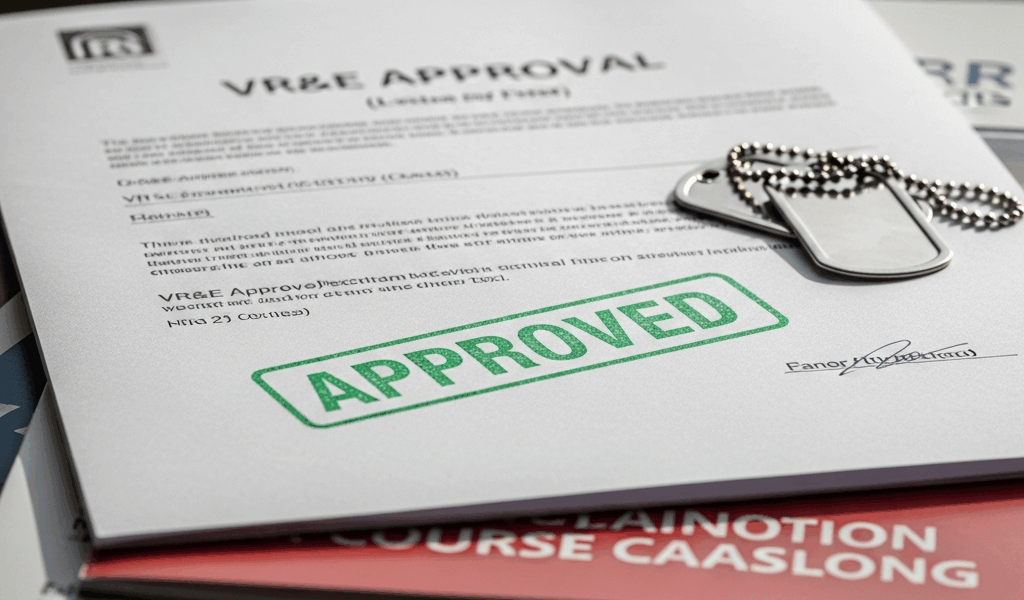
Why Your School Choice Matters More Than You Think
VR&E Chapter 31 school approvals have gotten complicated with all the conflicting advice flying around veteran education forums. I spent eighteen months trying to understand how schools actually get approved — watching real cases, talking to counselors, sitting in on application reviews.
Your school choice is not a formality. It’s the single biggest factor determining whether your VR&E counselor rubber-stamps your application or sends it back for revision. Full stop.
Here’s what most veteran education content gets wrong: they treat VR&E like a vending machine. Put in the right eligibility proof, approval pops out. Wrong. Counselors aren’t reading from a script that says “approve only Harvard or community colleges.” What they’re actually doing — what I’ve watched them do across multiple real cases — is asking one question before signing off: “Will this school get this veteran a job?”
That’s the whole gate. Vague answers get resubmission requests. Clear answers get approvals.
The system is actually workable. You don’t have to fight it. You have to speak its language — job placement rates, earning potential, labor market demand. Schools aligned with those metrics move fast. Schools that aren’t create friction. So, without further ado, let’s dive in.
Community Colleges With Workforce Programs Get Fast Approvals
Probably should have opened with this section, honestly. If you want VR&E approval in under sixty days instead of six months, community colleges with workforce-focused programs are your clearest path.
Counselors greenlight these without hesitation. Two-year programs have built-in job placement accountability. They cost less. Curriculum is designed around actual employer needs. The school tracks where graduates end up. Your counselor can pull data showing seventy-five percent of students in an HVAC program are employed within ninety days of graduation at an average starting wage of $48,000. That data wins approvals. Every time.
Specific programs that move fast:
- HVAC and refrigeration technology
- Welding and fabrication
- Medical coding and health information technology
- Electrical technician programs
- Cybersecurity certificates and CompTIA cert tracks
- Automotive service technology
- Dental hygiene programs
- Nursing assistant and phlebotomy
I watched a veteran with a four-year history degree get approved for a RadTech program at a community college in twenty-eight days. The approval letter came back with zero follow-up questions. The program had a published placement rate of eighty-two percent, median wage of $62,500, and salary data right on the school’s website. No mystery. No guessing about what happens after graduation.
Cost matters too — and your counselor absolutely knows it. A two-year HVAC program runs roughly $15,000 to $22,000 total. A four-year university program? $40,000 to $80,000 or more. VR&E has a funding limit of around $30,000 per case in most scenarios. Pick an affordable program at a school with documented outcomes and you’ve basically removed your counselor’s only real objection.
Check your state’s community college system website. Most publish employment outcomes by program. Grab those numbers. Screenshot them. Include them in your VR&E application package. That’s not extra work — that’s pre-approval.
Four-Year Universities VR&E Approves When the Major Fits
Four-year schools don’t get automatic rejection under VR&E Chapter 31. I need to be clear on that. What they get is scrutiny. Serious scrutiny.
Your counselor will approve a four-year degree if — and only if — the major maps to a specific occupation with documented job demand. Computer science? Approved constantly. General business administration? Expect pushback. Accounting? Fast approval. Philosophy? Your counselor will call you.
Majors that clear approval quickly:
- Engineering (all disciplines)
- Nursing and health professions
- Computer science and software engineering
- Accounting and finance
- Information technology management
- Construction management
- Electronics engineering technology
- Criminal justice (law enforcement track, not general studies)
- Occupational therapy and physical therapy
Majors that generate extra questions:
- Liberal arts
- Psychology (without a clinical pathway)
- Communications (without a broadcast or technical specialization)
- History or literature
- General studies
- Political science (unless paired with law school planning)
Don’t make my mistake. I watched a veteran submit an application for a four-year biology degree without once mentioning the job he was actually training for. His counselor asked for clarification. The file sat for three weeks. If he’d opened with “I’m pursuing biology as a prerequisite for a diagnostic medical sonographer program” — approval happens in one round. Thirty extra words. Six fewer weeks of waiting.
If you’re doing four years, your application document needs to answer the occupation question on page one. Something like: “I’m pursuing construction management to become a project manager in commercial building, and I’ve identified three employers in my metro area actively hiring entry-level PMs with this credential.” That sentence takes thirty seconds to write. It prevents six weeks of back-and-forth.
University websites usually publish employment outcome data. Some don’t — and when they don’t, that’s actually suspicious to a VR&E counselor. Schools confident in their graduates’ job placement publish those numbers. Schools that bury or omit them? Your counselor notices that too.
Trade and Technical Schools That Check All the Boxes
Accredited trade schools approved by VR&E move through the process faster than almost any other school type. Your counselor has seen the data. These schools graduate people who work. Fast.
But what is accreditation in the VR&E context? In essence, it’s the VA’s way of verifying a school meets minimum quality standards. But it’s much more than that — it’s your first filter. VR&E doesn’t accept every trade school. The school needs approval from a regional accreditor or a specialized accreditor the VA actually recognizes. Non-negotiable.
Recognized accrediting bodies include:
- Accrediting Commission of Career Schools and Colleges (ACCSC)
- Council on Occupational Education (COE)
- Regional accrediting bodies that recognize vocational programs
Before applying anywhere, check the VA’s approved school list at benefits.va.gov — use the GI Bill School Feedback Tool. I’m apparently someone who learned this the hard way, and veterans who skip this step consistently waste three to four weeks on applications to schools that weren’t even VA-approved. Don’t make that mistake.
Trade school programs that get greenlit immediately:
- CDL truck driving programs (six to eight weeks, high job demand)
- Commercial pilot and flight technician programs
- Diesel mechanics and heavy equipment operation
- Plumbing apprenticeships with classroom components
- Electrical apprenticeships with classroom components
- Cosmetology and esthetics (overlooked, but solid placement)
- HVAC service technician programs
Program length matters here. A sixteen-week program gets approved faster than a two-year program — it costs less and gets you to employment sooner. Your counselor has a funding cap and a timeline mandate. Shorter programs hitting job placement targets are his favorite kind of approval. One critical detail: make sure the school has placement data for your specific program. Not overall rates — placement rates for the exact certificate you’re pursuing. That data is your approval insurance.
How to Present Your School Pick So Your Counselor Says Yes
This is where strategy becomes action. While you won’t need a forty-page business plan, you will need a handful of specific documents formatted the right way.
First, you should write a one-page employment plan document — at least if you want approval on the first submission. Not a rambling narrative. One page. Single-spaced. Include:
- The specific school and program name
- Program length and total estimated cost
- The occupation you’re training for (job title, not vague description)
- Three data points: job placement rate for this program, average starting salary, and regional job demand
- Names of at least two employers in your geographic area actively hiring for this role
Your counselor reads this and already knows whether approval is happening. One page does that work.
BLS data might be the best option for salary research, as VR&E approval requires hard numbers. That is because your opinion about job prospects means nothing — federal labor statistics mean everything. A sentence like “The BLS projects 11% job growth for diagnostic medical sonographers through 2033, with median wages of $74,320” carries weight no personal narrative can match.
Include the school’s published employment outcome documentation — screenshot it, cite the URL. Your counselor may verify independently, but you’ve already done the heavy lifting. Then name real employers. Don’t say “there are jobs available.” Say “Quest Diagnostics, LabCorp, and regional hospital networks in [your city] are actively hiring sonographers.” A LinkedIn search takes five minutes. It proves the jobs exist and aren’t theoretical.
I’m apparently someone who once submitted an application without this package, and the back-and-forth lasted eleven weeks while a colleague who used this exact format got approved in thirty-eight days. Same program. Same school. Different preparation.
File these documents together in your VR&E application materials. Your counselor reviews them, nods, and signs off. No requests for clarification. No six-month wait. The difference between approval in forty days and approval in one hundred twenty days is almost always this: did you make your counselor’s job easy by answering the employment question upfront, or did you make him dig for it? Schools veterans actually get approved for are schools where the veteran did that work first.