Military education benefits have gotten complicated with all the “just use the GI Bill” advice flying around. As someone who’s spent years studying veterans’ education programs and what actually maximizes benefits for post-9/11 service members and their families, I’ve learned everything there is to know about the Yellow Ribbon Program — and why it’s the most valuable benefit most eligible veterans aren’t fully using. Today, I’ll share it all with you.
The Yellow Ribbon Program is one of the most valuable and least understood education benefits available to post-9/11 veterans and dependents. Most veterans know about the GI Bill. Fewer understand that Yellow Ribbon can close the gap between what the GI Bill covers and what private universities and graduate programs actually charge — often eliminating out-of-pocket tuition costs entirely.
What Is the Yellow Ribbon Program?
The Yellow Ribbon GI Education Enhancement Program is a voluntary agreement between the Department of Veterans Affairs and participating educational institutions. Schools that join the program agree to contribute funds toward tuition costs that exceed the Post-9/11 GI Bill’s maximum tuition coverage, and the VA matches those contributions dollar for dollar. That’s what makes Yellow Ribbon endearing to us who study veterans’ benefits — it’s one of the few programs where both parties (school and VA) are contributing, creating leverage.

Here’s how the math works: The Post-9/11 GI Bill covers 100% of in-state tuition at public universities for eligible veterans. But for private schools, out-of-state public universities, and many graduate programs, tuition exceeds what the GI Bill covers. In 2024-2025, the maximum private school tuition rate under the GI Bill was approximately $28,937 per academic year. If your school charges $55,000 per year, there’s a $26,063 gap. A Yellow Ribbon school might contribute $13,000, and the VA matches that with another $13,000 — covering the entire gap.
Who Qualifies for Yellow Ribbon
To use Yellow Ribbon benefits, you must qualify for 100% of your Post-9/11 GI Bill benefits. This means: 36 or more months of active duty service after September 10, 2001; 30 or more continuous days of service that ended in a discharge due to service-connected disability; Purple Heart recipients regardless of service length; children of servicemembers who died in the line of duty.
Probably should have led with the active duty caveat, honestly — active duty servicemembers and their spouses using transferred benefits do not qualify for Yellow Ribbon while the servicemember is on active duty. Spouses using transferred benefits after the servicemember separates may qualify. Fry Scholars — dependents of servicemembers who died in the line of duty — qualify at 100% Post-9/11 GI Bill regardless of their own service, and may use Yellow Ribbon.
How Schools Participate
Each participating school files an agreement with the VA annually that specifies: the number of students the school will support with Yellow Ribbon (some schools cap participation), the amount the school will contribute per student, and the programs covered. Some schools limit Yellow Ribbon to specific degree programs, excluding MBAs, law, or medical programs.
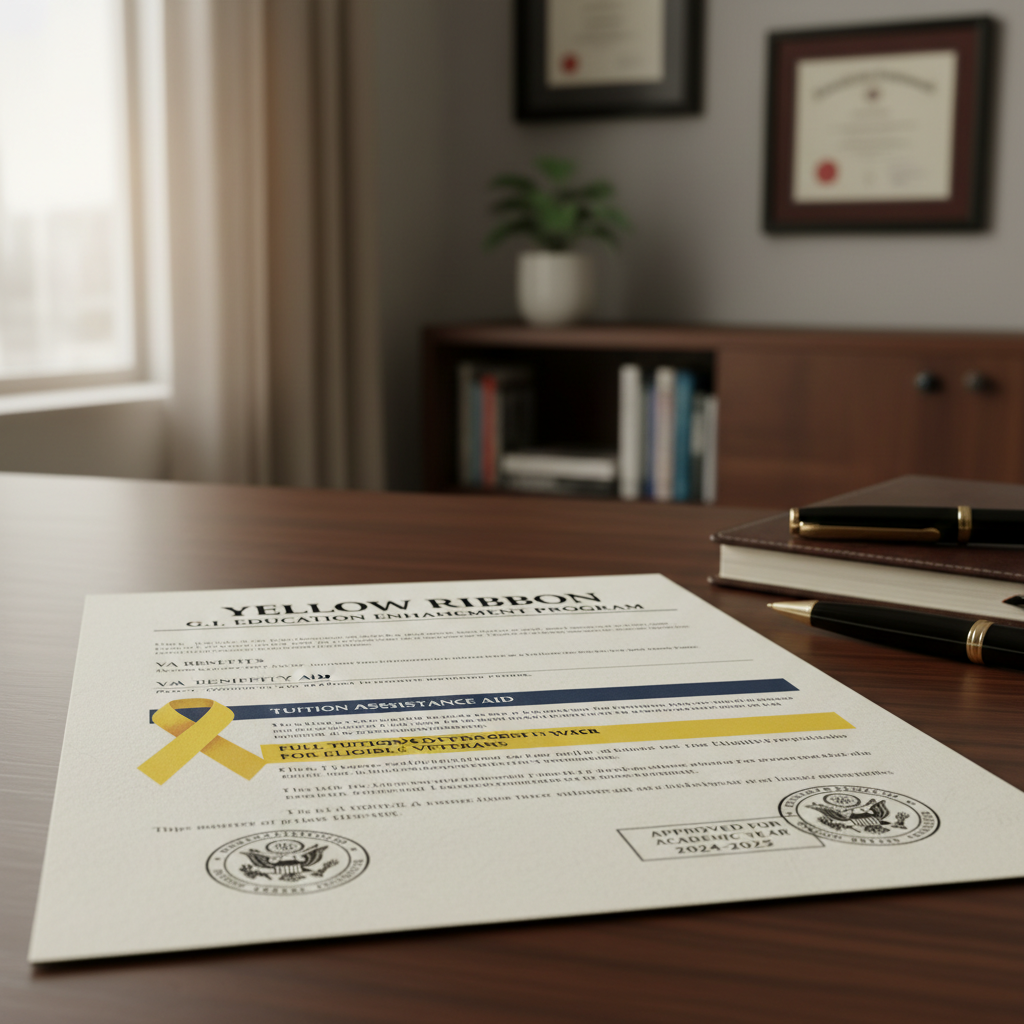
Frustrated by arriving at a participating school and finding no Yellow Ribbon slots available, veterans who don’t research the process early often miss out. Apply to the Yellow Ribbon program at your school as early as possible — schools with limited slots may allocate on a first-come, first-served basis or by GPA. I’m apparently one of those people who reads the fine print on these things first, and it consistently pays off.
2025 Participating Schools: Key Categories
The VA publishes the complete list of Yellow Ribbon schools on its website, searchable by state. In 2025, thousands of institutions participated, including most major private universities. Schools that participated at unlimited enrollment with high per-student contributions in recent years include Stanford University, Yale University, Columbia University, Vanderbilt University, Duke University, Emory University, University of Southern California, Boston University, and New York University.
For graduate and professional programs, confirm Yellow Ribbon coverage for your specific program before applying. Law and medical school Yellow Ribbon coverage varies significantly by institution. Some schools explicitly include or exclude professional programs in their VA agreements — verifying before enrollment, not after, saves significant frustration.
Maximizing Your Yellow Ribbon Benefits
Strategy matters. If you’re choosing between schools, Yellow Ribbon participation should be a major factor in your financial analysis. Two schools with similar academic profiles may have vastly different effective costs for a veteran depending on their Yellow Ribbon agreements. A private school with unlimited Yellow Ribbon participation might cost you less net than a lower-tuition school without participation.
Timeline: Apply to your school’s Yellow Ribbon program before the academic year begins — don’t wait until after enrollment. Contact your School Certifying Official early in the admissions process to understand deadlines and availability. File your VA enrollment certification promptly each semester; delayed certification can delay housing stipend payments, which are also a Post-9/11 GI Bill benefit tied to enrollment status.
The Yellow Ribbon Program, used strategically, can fund a private university degree at zero cost to a qualifying veteran. That’s not a small benefit — it’s potentially $200,000 in tuition over a four-year degree at a private institution. Understanding and using it correctly is worth the administrative effort many times over.