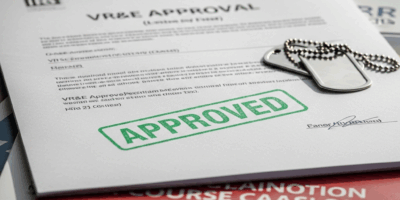
If you finish a class and receive a punitive failing grade, VA says you generally do not have to repay the GI Bill benefits used for that class. VA counts the failing grade as progress toward graduation requirements even though the school awards no credit, and you may use GI Bill benefits to take the required class again.
A withdrawal, nonpunitive grade, or failure to meet the school’s academic-progress policy is different. Those events can reduce certified enrollment, create an overpayment, or lead the school certifying official to report unsatisfactory progress. The exact result depends on the grade, timing, benefit program, school policy, and any mitigating circumstances.
Failing a Class vs Withdrawing: The Key Difference
| Outcome | Typical VA treatment | What to do |
|---|---|---|
| Complete the class and receive a punitive F | VA says repayment is not required for that class; the grade counts toward academic progress even without earned credit | Ask whether the course is required and can be repeated with benefits |
| Withdraw and receive a W/nonpunitive grade | Enrollment may be reduced from the effective date, potentially creating an overpayment | Contact the school certifying official immediately and report mitigating circumstances |
| Receive an incomplete | Treatment depends on whether it becomes a punitive or nonpunitive grade and whether the work is completed within allowed time | Get the school deadline and ask the certifying official how it will be reported |
| Fail to meet satisfactory academic progress | The school may warn, place the student on probation, suspend enrollment, or report unsatisfactory progress under its approved policy | Read the school policy and use its academic appeal process |
| Never attend or stop attending | The school must report the enrollment change; benefit adjustments and debts can result | Contact the school certifying official and VA promptly |
The terms “punitive” and “nonpunitive” are important. A punitive grade affects the school’s academic-progress calculation, commonly including an F with zero quality points. A nonpunitive grade does not count in the same way toward graduation requirements and must be reported to VA.
Will You Repay the GI Bill After Failing?
VA’s direct answer is no when the student finishes the class and receives a failing punitive grade. VA also says the student can take the same class again using GI Bill benefits. That does not erase the failing grade from the transcript or override the school’s repeat, GPA, financial-aid, or program rules.
The answer can change if the recorded outcome is not a completed punitive failure. If the professor or school assigns a nonpunitive grade because the student stopped attending or did not complete required work, the school may need to report a withdrawal or enrollment reduction. Ask how the exact grade will be reported rather than relying on the letter printed on an unofficial transcript.
What Happens When You Withdraw?
If you drop a class or withdraw after the term begins, VA may adjust benefits. For Post-9/11 GI Bill students, VA says the student may need to repay housing payments, while the school may need to return tuition, fees, and VA’s portion of Yellow Ribbon payments. The school may then apply its own tuition policy to the student account.
For Montgomery GI Bill and certain other programs that pay the beneficiary directly, the student may need to repay benefits received for the withdrawn training. Do not assume every debt belongs to the same party.
Notify the school certifying official before withdrawing when possible. Ask:
- How will the school code the grade?
- What effective date will be reported to VA?
- How will the change affect rate of pursuit or training time?
- Could housing, books, tuition, fees, or Yellow Ribbon payments be adjusted?
- What school balance could remain after VA recoups money from the school?
Mitigating Circumstances
Mitigating circumstances are events beyond the student’s control that prevent continued training or force a reduction in enrollment. VA examples include an unexpected illness or injury, an unavoidable employment transfer, a change in employment conditions, a family death or illness, an unexpected financial obligation, a course canceled by the school, unanticipated active duty, or loss of child care.
VA decides whether the circumstances are acceptable. Tell the school certifying official as soon as possible and provide a clear statement and supporting documents. The official can submit known mitigating circumstances with the enrollment change. Do not wait for a debt notice if the reason is already documented.
Mitigating circumstances may reduce how much must be repaid, but they do not guarantee that every payment will remain unchanged.
Satisfactory Academic Progress and GI Bill Benefits
VA-approved programs must enforce standards of academic progress. The school—not a generic online GPA chart—defines its policy. It may consider GPA, completion percentage, repeated courses, probation, maximum time, attendance, and program-specific requirements.
VA’s training for school certifying officials says the official should submit a termination for unsatisfactory progress when a student fails to meet the school’s approved standards. One failed class does not automatically equal benefit termination. The result depends on the student’s overall record and the school’s policy.
Get these items in writing:
- The current satisfactory-academic-progress policy
- Your current academic standing and calculation
- Whether you are in warning, probation, suspension, or dismissal status
- The deadline and requirements for an academic appeal
- The academic plan required for reinstatement
- What the school has reported or will report to VA
Can You Retake a Failed Class?
VA says a class failed with a punitive grade may be taken again using GI Bill benefits. The repeated course still must be part of the approved program and satisfy school and VA certification rules. A school generally cannot certify classes that do not apply to the program merely to raise enrollment status.
Ask the advisor and school certifying official to confirm that the repeat is required for graduation and will be certified. Separately ask the registrar how both grades affect GPA and whether the institution replaces or averages repeated grades.
What to Do Immediately After a Failing Grade
- Confirm the recorded grade. Determine whether it is punitive, nonpunitive, incomplete, or a withdrawal.
- Contact the school certifying official. Ask whether an enrollment amendment or termination will be sent to VA.
- Read the academic-progress policy. Do not assume one F causes suspension.
- Meet the academic advisor. Confirm whether the class is required and whether a repeat will count toward the program.
- Document mitigating circumstances. Provide them promptly if withdrawal or noncompletion resulted from events beyond your control.
- Watch VA and school notices. A tuition adjustment, housing debt, and school balance are different obligations.
- Use the formal appeal route. Follow the school’s stated deadline and evidence requirements.
If You Receive an Overpayment Notice
Read who created the debt and what payment it concerns. VA explains that schools are generally responsible to VA for Post-9/11 GI Bill tuition, fee, and Yellow Ribbon overpayments, while students can owe VA for housing, books, supplies, or other allowances. The school may separately charge the student under its tuition and refund policy.
Use the instructions in the notice to dispute the amount, request a waiver, arrange repayment, or appeal. Do not send documents to a guessed office. VA’s education line is 888-442-4551, and current debt options are available through VA’s debt-management resources.
What This Does Not Mean
- A failing grade does not automatically cancel all remaining GI Bill entitlement.
- Failing one class does not automatically get a student expelled from school.
- VA does not impose one universal minimum GPA for every approved program.
- A student generally does not report ordinary income or employment merely to keep Post-9/11 GI Bill eligibility.
- VR&E is a separate benefit with its own eligibility and planning process, not an automatic workaround for academic suspension.
Frequently Asked Questions
Do I owe VA money if I get an F?
Not when you complete the class and the F is a punitive grade, according to VA. A nonpunitive grade, withdrawal, or failure to attend can produce a different result.
Will the GI Bill pay to retake a failed class?
VA says the same failed class can be taken again using GI Bill benefits. Confirm that it remains required for the approved program.
Does an incomplete cause a GI Bill debt?
It can if the incomplete becomes a nonpunitive grade or is not completed within the applicable period. Ask the school how it will be reported.
Who should I contact first?
Contact the school certifying official, academic advisor, and—when benefit or debt treatment remains unclear—VA Education at 888-442-4551.
Official VA Sources
- VA: repayment after failing a class
- VA: withdrawals, mitigating circumstances, and debt
- VA: school-certifying-official enrollment scenarios
- VA: education overpayments and debts
This is general educational information, not an individual benefits determination. VA and the school’s approved policy control the actual case.